UN/CEFACT Verifiable Trade Documents
UN Verifiable Trade Documents (UNVTD) is a suite of lightweight, digitally verifiable specifications for the everyday documents of international trade — built on the W3C Verifiable Credentials data model and the UN/CEFACT Web Vocabulary . The guiding idea is simple: the document is the data itself — structured, machine-readable, and able to carry cryptographic proof of who issued it.
This site is the home of the specification and the case for adopting it. Use the sections below as a map.
Why it matters
International trade is enormous — roughly $25 trillion in annual exports, moving between some 10 million businesses as 2 billion consignments through 100,000 ports. Yet after 50 years of digitalisation effort, only around 10% of cross-border trade is genuinely digital; the rest still runs on paper and PDF, carrying the cost, fraud, and friction that come with them. That gap is the opportunity.
- Use Cases show how verifiable trade flows work across the trade lifecycle — order, finance, ship, clear, settle.
- Business Cases quantify why each stakeholder should adopt them — netting estimated benefits against a small, one-time implementation cost — with a published assessment methodology and supporting evidence.
What is a verifiable trade document?
In traditional trade, documents like commercial invoices or bills of lading exist as PDFs or paper forms. UNVTD takes a different approach: a document is structured JSON data carrying the same legal and business meaning as its paper counterpart. That same data can be:
- displayed as a human-readable web page,
- rendered as a PDF when needed,
- processed directly by software systems, and
- cryptographically signed to prove authenticity.
Verifiability means the data itself contains cryptographic proof of who issued it and that it has not been tampered with — enabling trust without intermediaries.
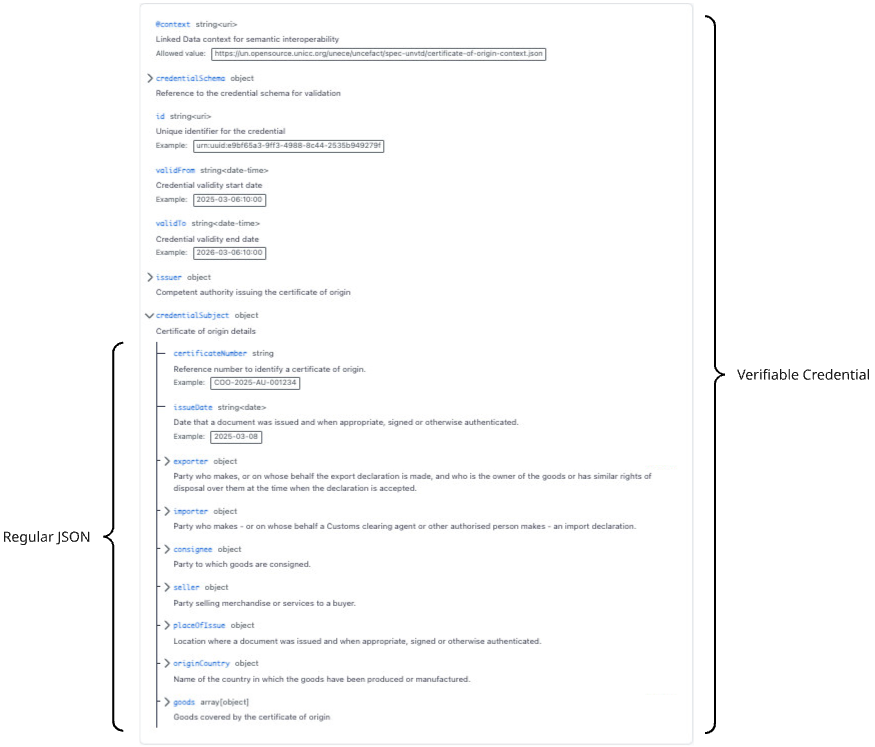
The verifiable trade documents
For each document the project delivers a JSON Schema (structure and validation), a JSON-LD context (semantic meaning, mapped to authoritative vocabularies), a worked JSON example, and a documentation page. The requirements baseline is the ICC-DSI KTDDE set of 36 essential trade documents — complete coverage of that set is the project’s success criterion — grouped here into the same four categories used by the KTDDE and the UN/CEFACT Web Vocabulary (what the KTDDE calls commercial, the vocabulary calls trade).
Trade
Transport
- Bill of Lading
- Sea Waybill
- Air Waybill
- Rail Consignment Note (CIM)
- Road Consignment Note (CMR)
- Ship’s Delivery Order
- Shipper’s Letter of Instructions
- Warehouse Receipt
Financial
Regulatory
- Certificate of Origin
- Preferential Certificate of Origin
- Customs Declaration
- Customs Bond
- Dangerous Goods Declaration
Architecture
UNVTD is decentralised and vendor-neutral by design. Trade documents are issued as portable verifiable credentials that travel with the consignment — no hubs, shared platforms, or counter-party dependencies required. The architecture rests on three pillars — portable credentials, business wallets, and transferable records — with trust anchored in the institutions society already relies on (national business registers, customs, IP offices) made digitally verifiable through Decentralized Identifiers.
See the Architecture overview for the goals, principles, and trust model.
Governance
UNVTD is developed as an open UN/CEFACT project. The Governance section covers its terms of reference, participation rules, and decision-making process, and points to how to join and contribute, the schedule of meetings, and current partnerships.
Implementation, testing & registering
The Implementation Guidance section is the practical starting point — a step-by-step path for traders, customs authorities, and software vendors. Implementations can be validated against the conformance test suite, and listed in the public Implementations Register of software systems and national initiatives.