Payment & Reconciliation
Settling the trade closes the loop: the verifiable invoice created at the start is now matched to payment and reconciled. This is where domestic tax compliance is realised — and where the heavy machinery of network-based e-invoicing turns out to be unnecessary.
The story today
The buyer pays; the seller matches incoming payments to invoices, issues or receives a remittance advice, reconciles its books, and reports for tax.
The work is manual and the assurance is weak:
- Reconciliation is manual — matching payments to invoices by hand, with mismatches and write-offs.
- VAT is under-reported — sales can simply be omitted, because the tax authority relies on each party’s self-reported figures.
- To gain visibility, some authorities mandate network e-invoicing where the tax office sits as a “5th corner” watching every message — heavy infrastructure, transaction fees, and a network both parties must join.
How it works with verifiable documents
The verifiable invoice from the buy-sell flow is matched to a verifiable payment or remittance credential. Because the invoice is authentic and machine-readable, reconciliation is automatic — and a tax authority that wants visibility is simply cc’d on the credential.
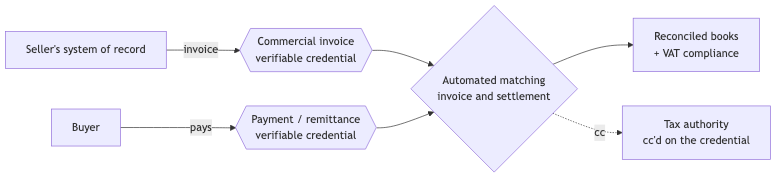
- The seller’s invoice (from buy-sell) and the buyer’s payment/remittance arrive as verifiable credentials.
- The two are matched automatically — invoice to settlement — with no manual reconciliation.
- The books reconcile themselves, and VAT compliance follows from authentic, matched records.
- A tax authority that wants oversight is cc’d the verifiable credential — no network membership, no central hub.
- The same architecture serves domestic and cross-border settlement identically.
Why this approach wins
Compared with network e-invoicing and the tax-authority-as-5th-corner model:
- More scalable — the tax authority is cc’d on a credential, not wired into a network, and one architecture covers both domestic and cross-border. Hub models need both parties on the same network and a separate cross-border build.
- Higher integrity — invoice and payment are matched, authentic, and attributable, so omitting a sale is far harder than under a self-reported return.
- Cheaper to implement — automated reconciliation rides the accounting systems businesses already run; there are no routing hubs and no per-transaction fees.
See the Implementation Model for why this beats the network approach.
What it’s worth
This flow realises:
- Revenue integrity — domestic — matched invoice-and-settlement records lift VAT compliance at the point the sale is proven paid.
- Operational efficiency — automated reconciliation in place of manual matching.
- Compliance & auditability — every settled trade is attributable and verifiable.
The value is quantified in the business cases — most directly for the Tax authority and the Trader.
Documents & learn more
- Documents: reusing the Commercial Invoice for settlement matching (a remittance-advice schema is on the roadmap)
- Previous in the lifecycle: Border Compliance · back to Buy-Sell
- How it scales: Implementation Model