Buy-Sell
The buy-sell flow is where a trade begins — and where its single most important document, the commercial invoice, is created. Everything downstream (finance, border clearance, payment, tax) reuses that invoice. Get it right, and the rest of the trade inherits the trust.
The story today
A buyer issues a purchase order. The seller ships the goods and issues a commercial invoice and packing list — on paper, or as a PDF emailed across.
That invoice is doing a lot of work. It is the seller’s demand for payment, but it is also the basis on which a bank will finance the trade, customs will value the goods, and both tax authorities will assess what is owed. Yet as a PDF it carries almost no assurance:
- The buyer cannot easily prove the invoice really came from the genuine seller — fake and altered invoices are a common fraud.
- The same figures are re-keyed into the buyer’s accounting system, the bank’s, the customs system, and the tax return — slow, costly, and error-prone.
- Tax authorities depend on each party self-reporting the invoice, leaving room for under-reporting and missing-trader fraud.
- Attempts to digitise it through e-invoicing networks require both parties to have joined the same network, routed through intermediary hubs.
How it works with verifiable documents
The seller’s existing accounting or ERP system — its system of record — issues the commercial invoice as a verifiable credential (VC): the same human-readable invoice, now cryptographically signed with the seller’s verifiable business identity, anchored to the national business register.
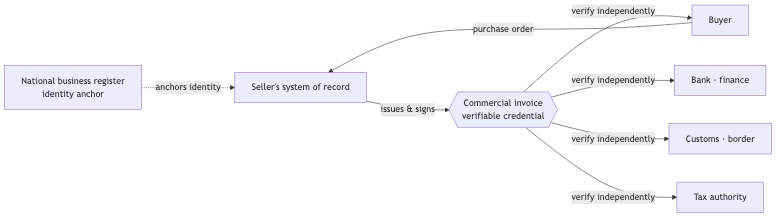
- The buyer issues a purchase order (optionally itself a VC).
- The seller’s system of record issues the commercial invoice and packing list as VCs, signed with its registered identity.
- The seller sends the invoice directly to the buyer — by any channel, because it is self-verifying and needs no shared network.
- The buyer’s system verifies the signature and the seller’s identity instantly, and ingests the data with no re-keying.
- That same invoice, unchanged, is later presented to the bank, customs, and the tax authority — each verifies it independently.
The invoice is both human-readable (it renders as an ordinary invoice) and machine-readable (the underlying VC).
Why this approach wins
Compared with centralised e-invoicing networks (the “4-corner” / “5-corner” hub model):
- More scalable — there is no network-membership assumption. The seller issues one invoice and sends it to anyone; the buyer needn’t be “on a network,” and the seller needn’t know who is. One invoice serves every downstream party. Hub models require both parties on the same network and force every issuer to check membership and route a network format or a PDF.
- Higher integrity — identity comes from the national register (the source of truth), the credential is tamper-evident, and nothing passes through intermediary hubs that reformat and store the data. There are no honeypots of sensitive commercial data and no weakening of assurance in transit.
- Cheaper to implement — the seller’s existing software issues the credential. There are no routing hubs, no per-transaction fees, and no intermediaries between seller and buyer. Hub models add infrastructure and transaction costs — which is why their uptake only ever follows a legal mandate.
See the Implementation Model for why this holds in general.
What it’s worth
This flow realises:
- Domestic revenue integrity — a verifiable invoice at the point of issue is the foundation of VAT and income-tax compliance.
- Operational efficiency — issued once, verified everywhere, with no re-keying.
- Compliance & auditability — every invoice is attributable and tamper-evident.
The value is quantified in the business cases — most directly for the Tax authority and the Trader.
Documents & learn more
- Documents: Purchase Order · Commercial Invoice · Packing List
- Next in the lifecycle: Trade Finance
- How it scales: Implementation Model