Border Compliance
At the border, customs must assess what duty is owed and whether a shipment is high-risk — today, from a declaration the trader asserts. Verifiable documents flip that model: the trader supplies authentic source evidence, and customs assesses obligations from it.
The story today
An importer or broker files a customs declaration, supported by a certificate of origin, permits, and the underlying commercial and transport documents. Customs assesses duty and runs risk-based controls.
The model rests on self-assessment of re-keyed data:
- Declared data is re-keyed from the invoice and transport documents — slow and error-prone.
- Valuation fraud and misinvoicing (under-declaring value to cut duty) are major sources of revenue loss.
- Origin fraud undermines preferential tariffs and trade remedies.
- Verifying it all manually makes clearance slow, while genuine traders wait.
How it works with verifiable documents
The documents customs relies on — the commercial invoice from the seller, the certificate of origin from the issuing authority — arrive as verifiable credentials from their authoritative sources, signed with identities anchored to national registers. Customs verifies them and pre-populates the declaration from data it can trust.
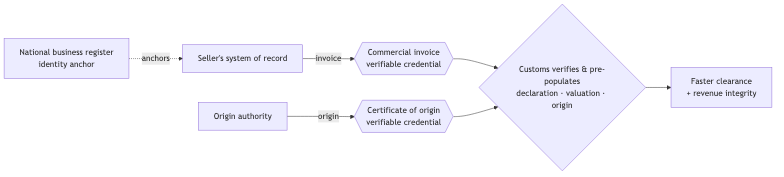
- The seller’s invoice and the authority’s certificate of origin are issued as verifiable credentials.
- Customs verifies authenticity and identity automatically, and pre-populates the declaration, valuation, and origin from the verified source data.
- The risk engine works on trustworthy data, so genuine trade clears faster and anomalies stand out.
- Cross-border exchange of value-consistent invoices between customs administrations deters misinvoicing — and, downstream, transfer-pricing abuse (counted under domestic revenue).
Why this approach wins
Compared with single-window portals and centralised customs platforms:
- More scalable — there is no requirement that every trader and agency join one platform; customs works with whatever verifiable documents a trader presents, from any system.
- Higher integrity — values and origin come from the source of truth and are tamper-evident, so misdeclaration and origin fraud are far harder to conceal.
- Cheaper to implement — the compliance model shifts from declaration to evidence (“give us your authentic documents and we assess your obligations”), cutting manual processing — and eroding the rationale for a heavy single-window in the first place.
See Portable Credentials for why network- and platform-bound models stall, and the Implementation Model for why the evidence-based model scales.
What it’s worth
This flow realises:
- Cost of trade — faster clearance and less documentary friction.
- Revenue integrity — border — verifiable values and origin reduce tariff and valuation fraud.
- Compliance & risk — risk-based control on trustworthy data; a secondary inflow to domestic revenue via transfer-pricing deterrence.
The value is quantified in the business cases — most directly for Customs, with the cross-border revenue link to Tax.
Documents & learn more
- Documents: Customs Declaration · Certificate of Origin · Preferential Certificate of Origin
- Previous / next in the lifecycle: Transport & Logistics · Payment & Reconciliation
- How it scales: Implementation Model