Trade Finance
Trade finance bridges the gap between an exporter who wants to be paid on shipment and an importer who wants to pay on arrival. A bank stands in the middle — and its entire job is to assess the authenticity and risk of documents and parties. That is exactly what verifiable credentials automate.
The story today
An exporter ships goods; a bank advances funds — through a letter of credit, a documentary collection, or supply-chain finance — against the trade documents: the commercial invoice, the bill of lading (which is also title to the goods), insurance, and certificates.
The whole arrangement rests on the bank trusting paper:
- Document checking is manual and slow — staff scrutinise paper for discrepancies; a large share of presentations are rejected first time, adding days and cost.
- Fraud is hard to catch — forged bills of lading, fake invoices, and double-financing (the same shipment pledged to two banks) are persistent losses.
- Due-diligence and KYC costs are high, so banks decline many smaller or unfamiliar exporters — a major driver of the ~$2.5 trillion trade-finance gap.
- A foreign exporter often cannot prove its own identity or its documents’ authenticity to the financing bank.
How it works with verifiable documents
The documents the bank relies on are issued as verifiable credentials by their authoritative sources — the invoice by the seller’s system of record, the bill of lading by the carrier — each signed with an identity anchored to a national register. The bill of lading is a transferable record, so its current holder (its control) is provable.
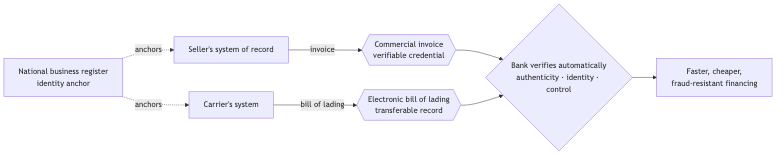
- The exporter presents the trade documents — invoice and electronic bill of lading — as verifiable credentials issued by their real sources.
- The bank verifies each document’s authenticity and the parties’ identity automatically, against the source of truth — no manual discrepancy hunt.
- The bank checks control of the transferable record: it confirms title and that the shipment has not already been financed elsewhere.
- The financing decision is accelerated and the due-diligence cost falls sharply.
- The same verifiable documents pass on to the importer’s bank, customs, and others — each verifying independently.
Why this approach wins
Compared with proprietary trade-finance platforms and blockchain consortia that put electronic bills of lading on a shared ledger:
- More scalable — a platform approach needs every party (exporter, importer, both banks, the carrier) on the same platform. Trades are dynamic, multi-party, and cross-jurisdiction, so that rarely holds. Verifiable credentials plus a standardised control protocol work no matter which systems each party uses.
- Higher integrity — identity comes from the national register, documents are tamper-evident, and control of the transferable record is cryptographically provable — so forged bills of lading and double-financing become detectable, without trusting any single platform’s walled garden.
- Cheaper to implement — automated verification replaces manual document examination and much of KYC; there are no platform membership or licensing fees, and banks fold verification into the systems they already run.
The control problem — proving who holds a transferable record — is the hard part, and why a protocol beats a platform. See Transferable Records and the Implementation Model.
What it’s worth
This flow realises:
- Trade & working-capital finance — lower information asymmetry and fraud risk close more of the finance gap, at a lower cost of capital, for more (and smaller) exporters.
- Compliance & risk — automated KYC, fraud detection, and double-financing prevention.
- Operational efficiency — automated document checking in place of manual examination.
The value is quantified in the business cases — most directly for the Bank, with finance access also benefiting the Trader.
Documents & learn more
- Documents: Bill of Exchange · Promissory Note · reusing the Commercial Invoice and Bill of Lading (letter of credit and documentary collection schemas are on the roadmap)
- Previous / next in the lifecycle: Buy-Sell · Transport & Logistics
- How it scales: Implementation Model