Business Cases — Overview
International trade is enormous — roughly $25 trillion in annual exports, moving between some 10 million businesses as 2 billion consignments through 100,000 ports. The cost, fraud, and friction embedded in its paper-based documentation are equally enormous — and that scale is the opportunity these business cases quantify.
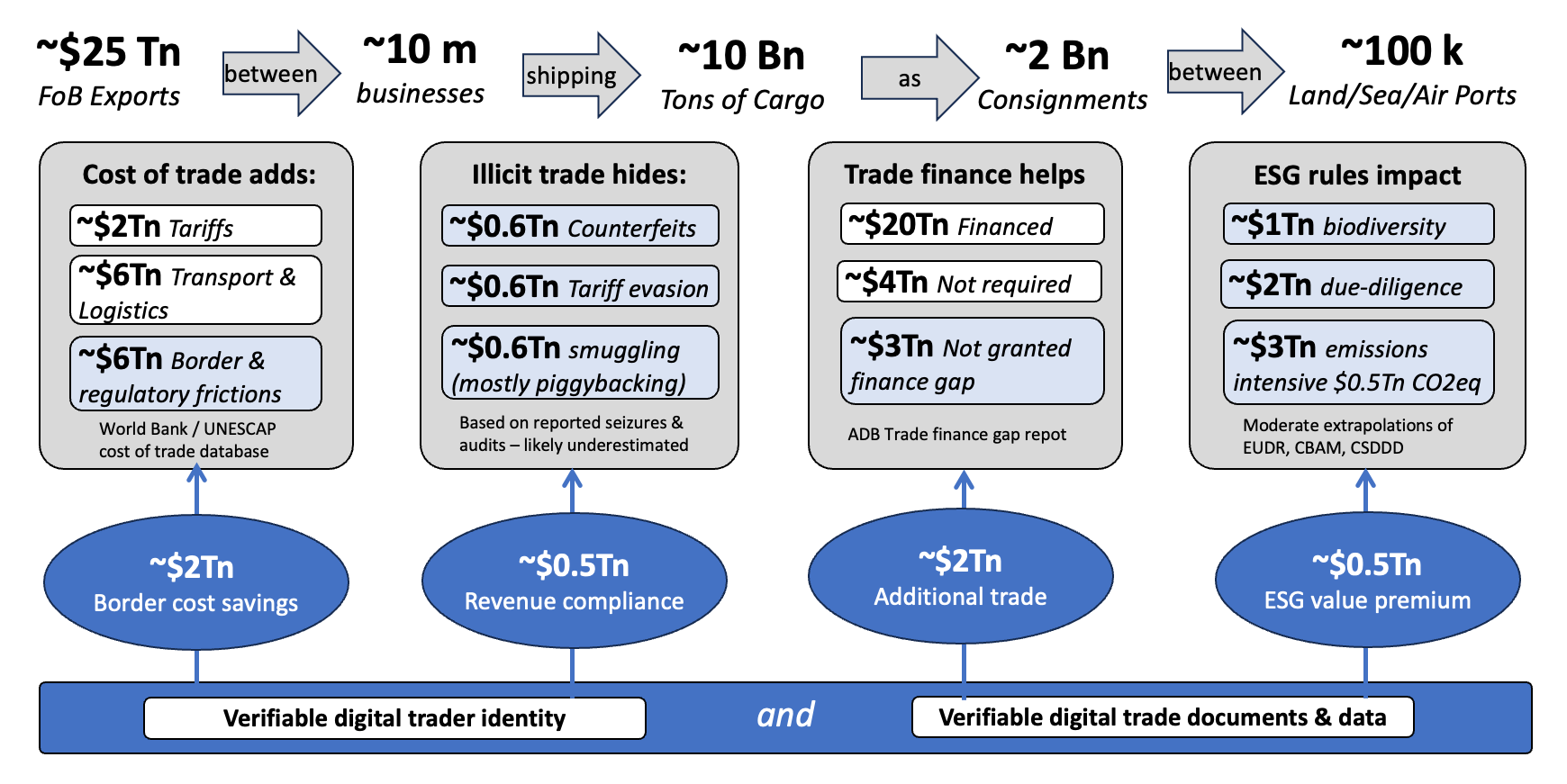
Where the use cases describe how verifiable trade flows work, the business cases quantify why each stakeholder should adopt them — netting estimated benefits against implementation cost to a payback.
Stakeholders
Each stakeholder adopts for a different reason. National stakeholders care about economy-wide levers — revenue, productivity, a deeper finance market; organisational stakeholders care about firm-level returns — cost, working capital, and the incentives offered to them for adopting.
National
Country / Government
The umbrella case: the national roll-up of cheaper trade, recovered border and domestic revenue, and a deeper trade-finance market — a measurable productivity gain delivered against a small, one-time decentralised cost rather than per-transaction fees.
Customs
Verifiable declarations let customs shift from sampled manual audits to algorithmic verification of every transaction — recovering more duty from a larger realised revenue pool, which in turn funds incentives (deferred duty, pre-arrival clearance) that pull traders into adoption.
Tax
Verifiable invoices close the VAT/CIT compliance gap by moving assurance coverage from under 1% of transactions toward ~100%, adding a deterrence effect that lifts voluntary compliance — all at far lower cost than audit-led enforcement.
Ports
For cargo-terminal operators, verifiable arrival, release and delivery documents cut dwell time, demurrage and manual document handling, speeding cargo through the terminal and improving asset utilisation.
Registry Operator
The national identity/credential anchor every other lever depends on: by issuing verifiable business identity at near-zero marginal cost per entity, the registry underwrites the trust that makes decentralised verifiable documents work — without the per-entity fees of intermediary identity schemes.
Organisational
Trader
Fewer documentary disputes and faster, more certain clearance — but the largest gains often arrive as incentives: deferred duty, expedited clearance, and cheaper trade finance offered by the parties that benefit when the trader’s documents are verifiable.
Logistics
Verifiable transport documents (eBL and equivalents) cut document handling and courier cost, reduce mis-delivery and title-fraud liability, and speed equipment turnaround through faster cargo release.
Bank
Verifiable documents and identity automate KYC and trade-document due diligence and expose double-financing and fraud — lowering the cost of assurance while making more SME trade safely financeable.
How the numbers are derived — see the Assessment Methodology.
Generating your own. Each stakeholder page presents the generic case and offers two ways to make it specific to your country or organisation:
- Light — attach your own document and paste the page’s prompt into your preferred AI model for a quick, editable draft.
- Full — clone the repository and run Claude locally for exact, data-grounded figures.