Identity Anchoring
The problem: signatures don’t prove identity
A cryptographic signature proves a trade document was signed by a specific DID and has not been tampered with. It does not, on its own, prove who owns that DID. Any party can generate a DID and sign a document — the signature is meaningless until the verifier knows the DID belongs to a legitimate, identifiable business.
Trust is institutional, not technical. It is built by regulators, national registers, accreditation bodies and the professionals who operate them — and technology only makes those existing trust systems digitally verifiable. An identity anchor is how that institutional trust is attached to a DID.
What an identity anchor is
An identity anchor is a verifiable credential, issued by an authority society already relies on — a national business register, a customs authority — that asserts a specific DID belongs to a specific registered entity. The authority issues the anchor to the business, binding the business’s signing DID to its real, registered identity.
Confirming the authority: the UN GRID
Anchoring the business to an authority only helps if the verifier can also trust
the authority. Is registradores.org or registradore.org the authoritative
Spanish register? There are over 1,000 authoritative registers globally, and a
verifier cannot be expected to know them all.
This is resolved by listing each authority on the UN/CEFACT Global Registrar Information Directory (GRID) . The authority issues a digital identity anchor to the business and is itself a member of the GRID, so the verifier can be sure both that the business is who they say they are and that the authority is genuine.
Relationship with the GRID
The GRID is a separate UN/CEFACT project that maintains the authoritative, discoverable directory of the world’s trusted registrars — the top of every trust chain. UNVTD does not run or duplicate it; the two are deliberately decoupled:
- UNVTD defines the verifiable trade documents and the identity anchors that bind a business’s signing DID to its registered identity.
- The GRID answers the remaining question — is this registrar a genuine authority? — by publishing the DIDs of accredited registrars so that any verifier can resolve the final hop of a trust chain.
UNVTD consumes the GRID: an identity anchor is only fully trustworthy when the issuing authority resolves to a GRID member. Because the GRID is an independent directory rather than a platform documents pass through, UNVTD implementations can also use any other equivalent trust framework where a GRID entry does not yet exist.
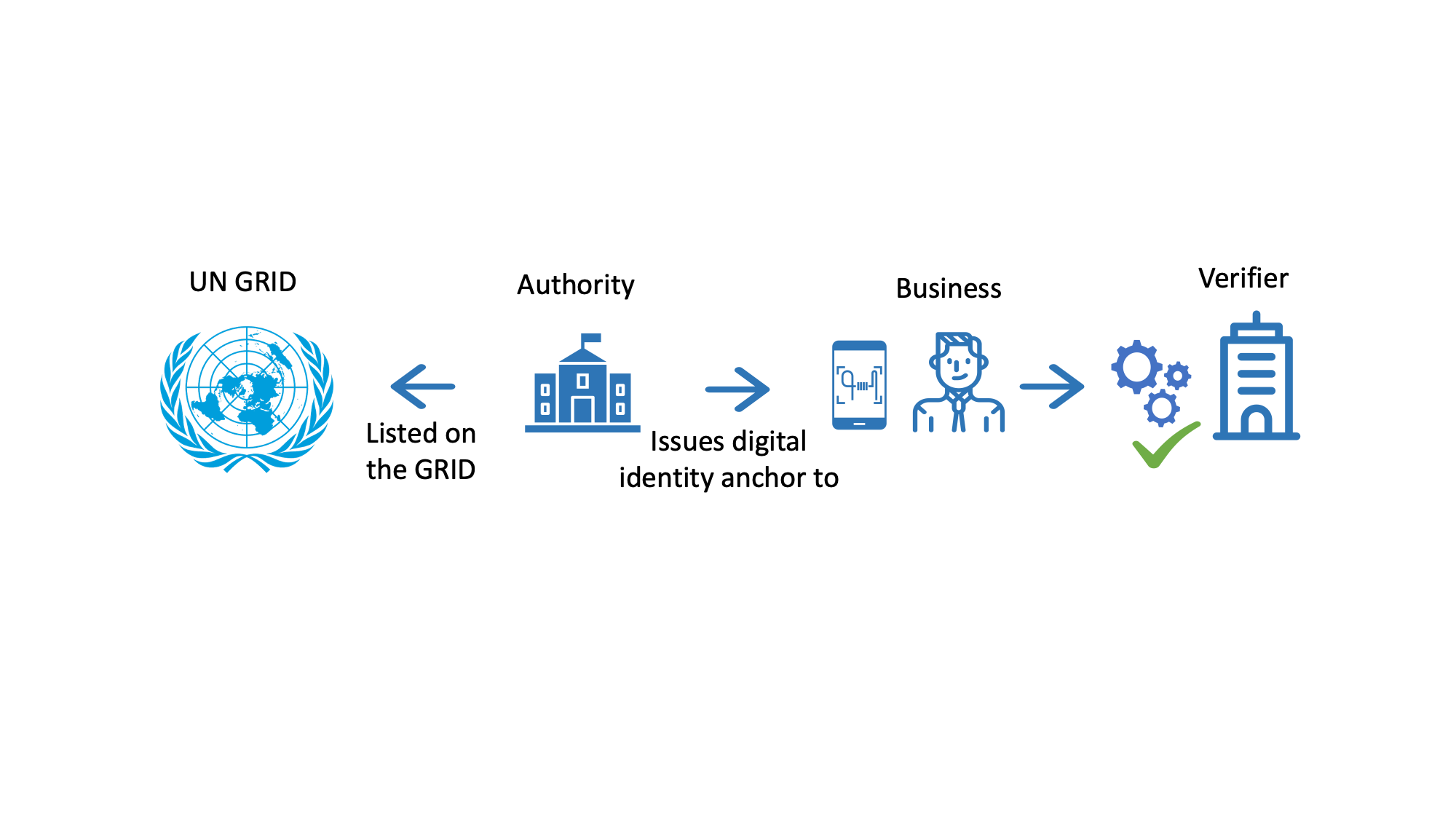
This is exactly how passport verification already works: ICAO maintains a register of national passport issuers, so a border officer can trust a passport from a country they have never dealt with. The GRID does the same for the world’s business registers and other authorities.
Trust chains
Verifiable Credentials (VCs) carry the claims of value; Decentralised Identifiers (DIDs) are the cryptographic glue linking each claim to the next. Following the chain from a document back to a UN-anchored authority is what lets a verifier trust a counterparty they have never met — every hop is an automated check that the credential is valid, unrevoked, and issued by the expected party.
Example 1: the commercial invoice
A commercial invoice VC is issued by the exporter’s DID. That DID is the subject of a business registration VC issued by the national registrar, whose DID is in turn the subject of a GRID membership VC issued by the UN. Walking the chain, the verifier confirms that the invoice is valid and not tampered with or revoked, that it was issued by a verified business identity, and that this identity is vouched for by a genuine national authority.
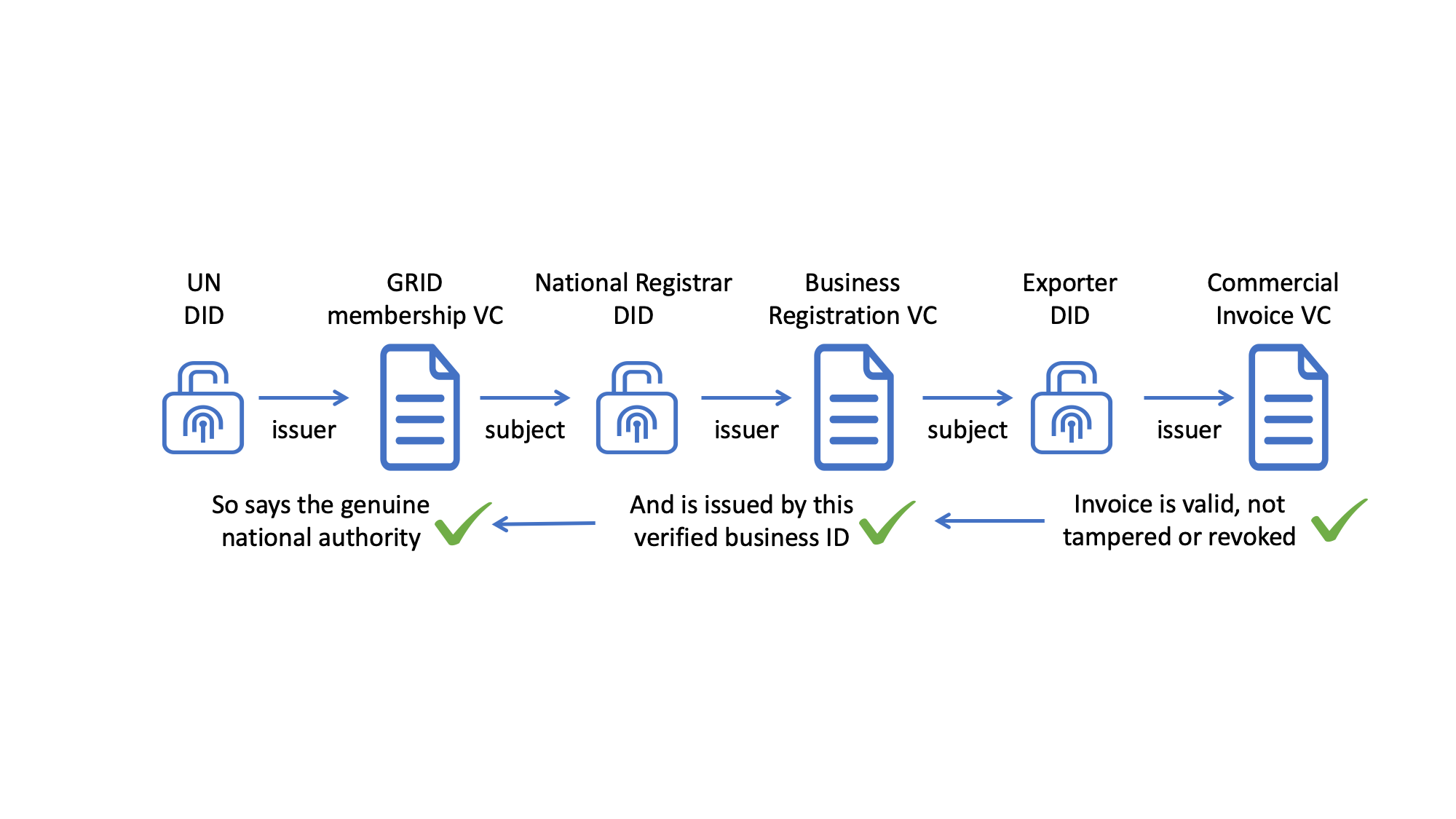
With that chain resolved automatically, an importing customs authority can pre-clear the shipment and a trade finance provider can approve the finance.
Example 2: product conformity
The same pattern applies to quality and conformity claims — only the authorities change. A conformity certificate VC is issued by an auditor’s DID, which is the subject of an accreditation VC issued by the accreditation authority, whose DID is the subject of a membership VC issued by GACI (the accreditation sector’s equivalent of the GRID). The verifier confirms that the certificate is valid and unrevoked, that it was issued by an accredited auditor, and that the accreditation is vouched for by a genuine accreditation authority.
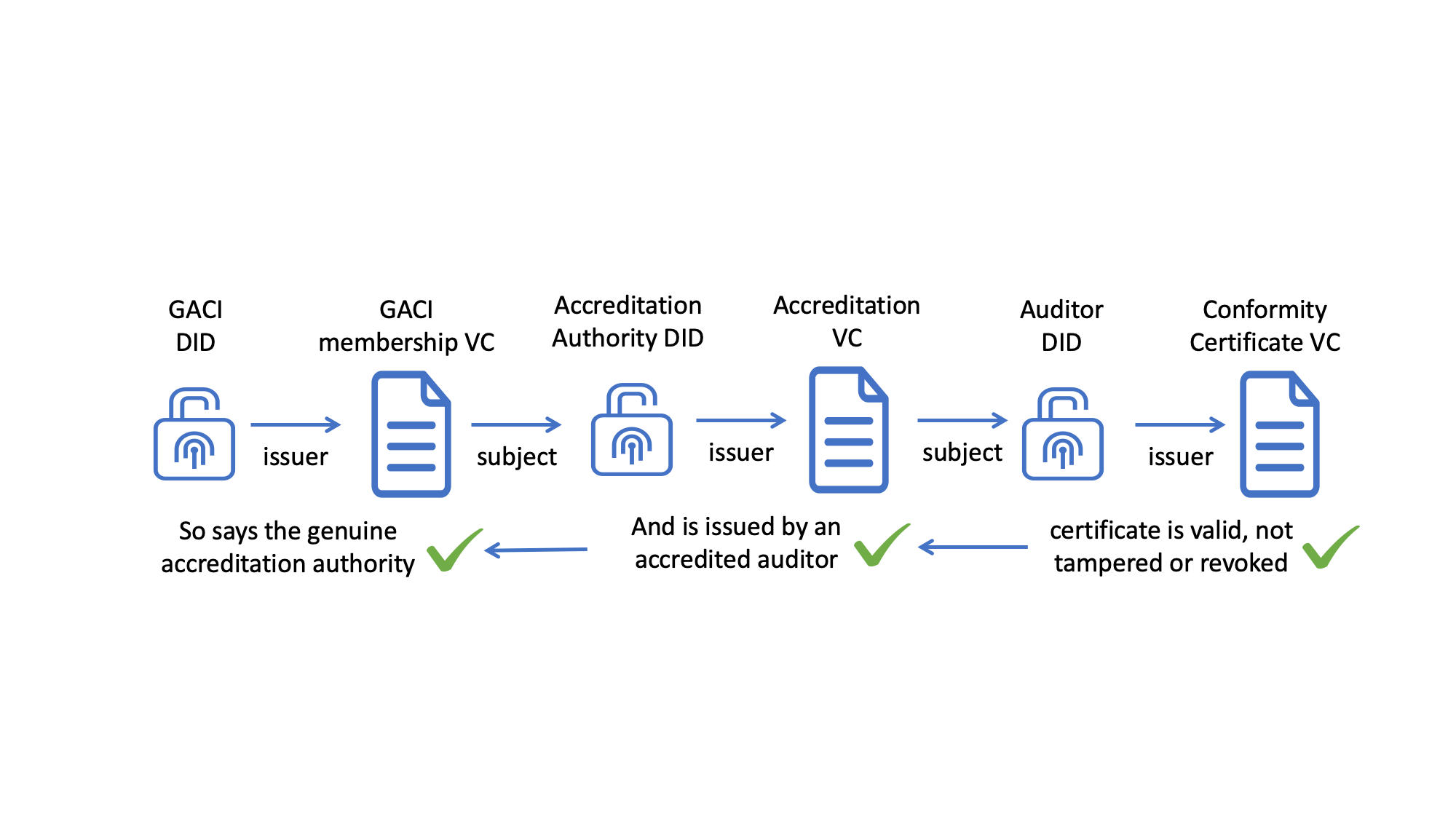
On this basis an environmental competent authority can issue a permit, and a corporate buyer can confidently buy the supplies.
Trust without central infrastructure
No single global identity system is required. Trust remains institutional — the same authorities that businesses and auditors are already registered with. The GRID and its accreditation-sector counterpart simply make those existing registrations discoverable and verifiable; they are not a new platform that documents must pass through, and they remain architecturally independent from UNVTD itself.
Further reading
The UN Transparency Protocol (UNTP) develops complementary standards for supply chain transparency and defines a Digital Identity Anchor specification covering this pattern in detail.